
TJ Chambers

© vecteezy.com
These posts are typically triggered by a recency of events, excepting ongoing projects when covered by various non-disclosure and commercial confidentiality agreements.
What the various news algorithms prompt, as well as by what past and present industry colleagues may whisper, and the no-doubt delusional belief of the author to be able to divine (a more inspirational version of ‘guessing’) or intuit meaning where little is immediately apparent within the daily wash of corporate PR, advertorial, media amplification and fake social media celebration.
The posts also reflect the author’s cultural and commercial ‘obsessions’ or more abstractly, variations upon a theme. And they represent an attempt to cut-out-the-noise, whilst conversely also contributing to the relentless barrage of more, and yet more content.
They are also typically centred around the evolving live entertainment / ticketing industry landscape – which positively also appears to trigger the interest of readers from around the world, so for this post welkom, huānyíng guānglín, bienvenidos, and witamy to all the new readers.
***
Since the last scribble, I temporarily succumbed to a bout of feverish ‘man-flu’, or Covid-19 (BA 3.2 Cicada variant), or another unhealthy autumnal bug.
And so, I lost somewhere between 48-96 hours in a sweaty-but-cold, constantly tired but wide-awake in the middle-of-the-night, unpleasantness. During which the citrus fruit-flavoured Paracetamol and Phenylephrine Hydrochloride, aka Lem-Sip (other cold and flu relief medicines are available) didn’t really work, but plenty of sleep (eventually) did.
***
Elsewhere, John Wiltshire at Ticketmaster UK Clubs, had organised an event, and a couple of friends then enquired as to whether I would be attending.

TicketWeb UK officially signing off!
It’s a big moment, and a bittersweet one for many of us.
For more than 25 years, TicketWeb has been part of our UK history. It was one of the first companies to sell tickets online, and from its early home above Brixton Academy, grew into a trusted platform for independent venues, promoters and music fans. It built a brilliant business and countless lasting relationships along the way.
This month marks the end of the TicketWeb journey in the UK, but the people and expertise behind it aren’t going anywhere. The same brilliant team will continue this work as Ticketmaster Clubs supporting our clients on Universe and helping the business thrive.
A huge thank you to everyone who has played a part.
https://www.universe.com/events/ticketweb-goodbye-party-tickets-7W0NZQ
***
If this was a movie, the screen would now reveal film projector stock slowing, then stopping. Before apparently catching alight, with the screen then bleeding to a whiteout.
As the white dissolve then fades, the next sequence would have a heightened contrast and unnatural colours, and feature a vaguely familiar cast, possibly trimmer, younger, and dressed in yesteryear fashion.
***
1997-98
During the formation of the McKenzie Group (emerging from the music division of Break for the Border Group PLC – another story for another time), the two venues Shepherd’s Bush Empire and the Brixton Academy, needed a new ticket retail solution, and it was my job to help source it.
‘Shaky’ John Woodburn had previously written in MS-DOS a basic ticket manifest solution which enabled the self-styled ‘box office babes’ (Sam, Lorna and Fleur) to sell via walk-up and telesales, primarily for the Academy but also for ‘hard stock’ (pre-printed tickets) allocations from the Empire.
Having previously been at the Marquee, the Astoria / LA2 and other venues, the main ticket retail options then available were to part-externalise operations, whilst also potentially attracting a basic level of sales commission, and work with the retail agent Ticketmaster (then operating in newly established Leicester Square offices); the Nottingham-based coach tour + ticket bundler Way Ahead (before it was acquired by TeleWest, then Really Useful, then rebadged as SeeTickets, then acquired by Vivendi, and finally, or at least most recently, CTS Eventim); or Stargreen Box Office a ticket retail outlet in Argyll Street, where managers Barry and Debbie held cash floats for all the major promoters of the day, and which was eventually acquired by Encore Tickets before their own sale to TodayTix.
The alternative to any of these options was to ask ‘Shaky’ John to attempt to write a new ‘Academy Tickets’ solution (a query to which he forcefully replied in the anatomically negative), or to consider licencing a self-serve platform or not-for-profit performing arts solution e.g. BOCS, Dataculture (eventually acquired by Tickets.com), PASS, HEBOS (Hackey-Empire-Box-Office-System aka Hackney-Empire-Bums-On-Seats), Wembley Box Office etc.
Instead of which, there was the ‘world wide web’, which in 1997-98 was just about a thing, albeit you needed a dial-up account, and download speeds were i-n-c-r-e-d-i-b-l-y slow, whilst graphical images, let alone animation, were to be avoided. But it was the near future. And surely the answer was ‘out there’.
***
Rewinding a little further, whilst at KCLSU (Kings College London Students Union), circa 1995, (Pleasure in the possibilities and personalities of old: Nostalgia Part #2 – https://tjchambers.blog/2025/06/06/pleasure-in-the-possibilities-and-personalities-of-old-nostalgia-part-2/) a member of the student staff, name of Ben Drury, Co-Founder + CEO Yoto (https://www.linkedin.com/in/bedrury/) was forever telling everyone about this soon-some phenomenon, the internet, or the world wide web. And you could always read the latest edition of the ‘Whole Earth Catalog’ (a printed precursor of contemporary cultural obsessions: conspiracy theories; tech; si-fi; jam bands; the arrogance of youth; and the transformative impact of the internet etc.) whilst waiting for pages to download. (See: https://en.wikipedia.org/wiki/Whole_Earth_Catalog.)
Anyway, back to the TicketWeb (UK) story.
***
1998-99
The search for the future in ticketing eventually led to a U.S. web 1.0 start-up (TicketWeb LLC), who at that point were operating out of Oakland above a Chinese takeaway.
And Ian, aka Ian McKenzie Howard principal owner of the McKenzie Group (MKG), which eventually became the Academy Music Group (AMG), decided that TicketWeb’s aspirations to grow out of San Francisco could be matched with MKG’s desire for a future-facing in-house box office solution.
After a few months of late-night calls and various faxes, it was decided that Andrew Dreskin (TicketWeb Co-Founder and CEO) and Rick Tyler (TicketWeb Principal Software Engineer and Co-Founder) would come to London to finalise the details of a proposed ‘joint venture’.
The process had taken longer than wanted, in part because TicketWeb (US) was negotiating with African Media Entertainment (AME) to launch in South Africa – which was finally announced in October 1998.
Via AME, TicketWeb (ZA) gained ties to concert promoter Attie van Wyk of Big Concerts (who many years later joined Live Nation), Johannesburg venue The Dome, and sports marketing and event management firm Pro Touch Promotions, and completely disrupted the local ticketing market where Computicket had operated for twenty-seven years without meaningful competition.
Anyway, back in the UK, by the time both sides were ready, Ian was ill, John Northcote (Ian’s right hand, genuinely nice guy, and the man largely responsible for the eventual formation of the £33.5M Academy Music Group in 2004) wasn’t available, and so rather than drag Rick over, I alone met with Andrew at the Oxo Brasserie – which had opened in September 1996 as a Harvey Nichols restaurant, had great views of the Thames, and a decent plate of food.
Sometime during the first, or maybe second bottle of red wine of ‘negotiations’, it was agreed I would continue to manage the two venues and to also lead the launch of TicketWeb (UK), a joint venture with MKG. And so Masterstream Ltd t/a TicketWeb (UK) was born.
***
D-I-Y
When people now consider launching a ticketing services platform there are various operational templates, online guides and a vast army of human hands-on expertise (obviously now being aggressively replaced by AI) in mobile apps and ecommerce – storefront and marketplace design, event discovery and listings, pricing, promotions and fulfilment, and familiarisation with HTML, CSS, SEO, SEM, CTR and all the other three-letter-acronyms.
None of that existed.
Or if it did, we didn’t know about most of it.
Then – 1998 – everything needed to be built (both systems and operations), often for the first time. And located in Brixton, in rooms above the venue, often without the ability to easily ask west-coast colleagues (even in if they knew, as they were also learning in post at the same time), with a negligible budget given the cautious nature of MKG – as they were only seeking an in-house ticketing solution.
So, there was a constant series of critical technical queries – data management and encryption, disaster recovery, load-balancing, mirrored system back-up, payment processing, system audit and security protocols, etc. – that all urgently needed resolving.
And seemingly all written in a different language: Apache, C++, Java, Perl, Python etc.
But this was the beginning of Web 1.0, and we were D-I-Y building the future, without an operators’ manual.
For example, we needed to build a localised server capable of handling a number of simultaneous requests of the core database – would 50 users’ capacity be sufficient? Or 100? Or more? We had some confidence that there were soon-come online customers ‘out there’ albeit in unknown numbers, and who knew whether they would be sufficiently confident to then share their payment details. So, for example drafting FAQs about what the migration from http to https and what the SSL (Secure Sockets Layer) padlock logo meant.
Or how to design a system admin back-end that provided real-time sales reports within defined period settings, across individual client accounts and/or company-wide, without swamping the core database – with one temporary resolution proposed that we only run UK company reports after trading hours, whilst also switching off the public site for a hour or two around midnight to enable day-end financial reconciliation and also to allow system upgrades, and/or rollbacks when it didn’t work first time.
Another particularly interesting ‘feature’ of the first iteration of the #T1 code was the impact of BST (British Summer Time) on the system suite of daily sales reports. And Y2K was a semi-serious concern for a week or two.
As was the need to retro-engineer another data field as the gross transactional value moved from tens to hundreds of thousands to a million plus, all accompanied by the need to extract accounts data via CSV files. (With thanks to David Altman for his patience and accounting expertise through the early period.)
Elsewhere, John, and his ‘apprentice’ Michael Minchin (who had the internship from hell, but who appeared to enjoy it and devoted efforts above and beyond) had heroically soldered-together a series of second-hand 4GB hard-drive computers, arranged on some metal shelving in a storage cupboard with two air fans running 24-7. And that was the local ‘server farm’. And it kind of worked. Most of the time. We even bought a circuit breaker to protect against power surges etc. after a while.
***
1999
There was no public statement until we had sold a couple of tickets off the platform, but on the 4th January 1999 ‘the joint venture with the McKenzie Group Ltd., owners of the Brixton Academy and Shepherd’s Bush Empire, two of London’s popular music venues’ was announced, and for the first year or so, the TicketWeb (UK) event listing was often the only online presence for the featured artist, attraction, promoter, or venue.
But during this time, we knew that we also needed to maintain a tele-sales option (020 771 2000), and initially that drove the majority of the volume of sales. But within a year of launching ‘online’, as we increasingly started to refer to this new sales channel, and with it always being the cheaper consumer purchase option, it grew to dominate sales.
Because of some pre-existing promoter (MCP, Metropolis Music, PCL, Regular Music, Riverman, SJM Concerts etc.) and venue relationships (ranging from the Scala, the Leadmill, to the Limelight Club, Crewe), and then via an introductory panel at ILMC #12 (when Martin Hopewell still led the conference), where the pitch was: ‘We’re not from ____________ (the local dominant platform); we’re longstanding peers and colleagues and have worked alongside you as agents, promoters, venues and now ticketing; we don’t want exclusivity – in fact, give us an ‘online-only allocation’; sale-or-return; your brand matters; we’re cheaper to the customers’, and yes, we can, if desired pay a reasonable level of rebate’) we were able to convince some early-adopters of TicketWeb (UK).
These also included the Bowlie Weekender / All Tomorrows Parties (a partnership that eventually ended in tears), the Big Chill Festival, Guildford Live, the Bulldog Bash (an annual motorcycle rally founded by the Hells Angels, courtesy of an introduction via Josh, the stage manager at Brixton Academy) and others.
And elsewhere Andrew Dreskin then convinced the Louvre, in Paris that TicketWeb was the right ‘browser-based’ partner for their online ticket sales.
So, after the first year’s trading TicketWeb (UK) was a major new ticket outlet, going from zero to over 250K tickets sold, with a doubling of that envisaged during 2000.

TicketWeb (UK, Latest Attractions, circa 1st March 2000
However, behind the scenes, tensions between the aspirations and expectations of MKG and TicketWeb had become more apparent.
Essentially, MKG was happy with a fully-functioning (ha!) in-house box office ticket retail system for the two venues and was also pleased at the growing adoption elsewhere (with the implicit growth in enterprise valuation of the JV), whereas TicketWeb wanted to grow beyond those operational and corporate confines, and so impatience over the level of localised fiscal and operational support eventually led to a mutually agreed parting of the ways.
Again, these discussions took longer than envisaged but eventually TicketWeb (UK) became a wholly owned subsidiary of the US-parent and separately agreed a multi-year agreement with the MKG venues.
***
The Future Is Female
Aside from building an online ticketing agency from scratch, perhaps the greater achievement is that TicketWeb (UK) enabled a generation of ticketing industry movers, shakers, and leaders, many of whom were women, but all of whom started in Brixton.
For example, Sam (Arnold) Isles who went from TicketWeb (UK) to become a leading executive within Ticketmaster UK and then across their international markets with special responsibilities for Artist Services, GA Ticketing and Universe (https://www.linkedin.com/in/sam-isles-696030a/).
Sian (Snelling) Egbujie, every client’s favourite onsale manifest manager at TicketWeb (UK) who has since held a number of senior executive roles at Ticketmaster UK, SeeTickets, Eventbrite, Dice and most recently with AXS in Europe (https://www.linkedin.com/in/sianegbujie/).
Janine Douglas-Hall who has led operational teams across the ticketing, live events and contactless payments sectors started with TicketWeb (UK) then Ticketmaster UK, TicketArena, Tappit, and most recently returned to Ticketmaster in Europe (https://www.linkedin.com/in/janine-douglas-hall/).
Lou Champion, who is also a fine artist in her own right, started with TicketWeb (UK), then led ticketing operational teams at Kilimanjaro Live, 2012 Olympics, Mama Group, FKP Scorpio and is now Director of Ticketing at The O2 Arena, London (https://www.linkedin.com/in/louchampion/).
Not everyone else reached those heights but Claudia Castellanos, Florence Stewart, Jo Hill, Sarah Russell, and Becky all made massive contributions to TicketWeb (UK) in the early days, and all went on to have long and successful careers.
And why where these women so important.
Simples. Because they brought smarts, energy, calmness and clarity to the chaos of the MVP that was the early iteration of TicketWeb.
They collectively problem-solved and kept things moving forward.
They socialised (‘laughter and tears’) the relationships with clients and resolved any customer service issues with empathy and transparency.
They set a standard of behaviour, delivery and execution, and arguably inspired a generation of colleagues and industry peers.
And they were much more fun than the grumpy old men desperate to cling to the old ways of doing business.
Unfortunately, the ticketing industry, and society in general, is still limiting the advance of women, or those of differing sexual orientation, ethnicity, religion (or none), so I’d like to believe TicketWeb (UK) made a small but positive impact.
And I was genuinely lucky to work alongside them.
***
TicketWeb (UK) also went on to provide an introduction to ticketing for other talents such as Steve Machin, exemplar serial entrepreneur and innovator (https://www.linkedin.com/in/stevemachin/) whose restless energy continues to amaze; Jez Aspinall (https://www.linkedin.com/in/jez-aspinall-34310b40/) from TicketWeb to SJM and a ‘true blue’ (CTID); Neil Evans (https://www.linkedin.com/in/neil-evans-5a68151b9/) whose long career in TicketWeb and Ticketmaster has overseen the development of artists, clubs and all things independent, and is also another ‘Blue’ Mancunian exile; and TicketWeb (UK) post TM-CS acquisition also provided a career springboard for a generation of biz dev / sales exec’s including Collete, Dawn, Magaret, Dom (https://www.linkedin.com/in/domsmyth/) and Andrew (https://www.linkedin.com/in/andrew-parsons-30b4623a/), with the latter plucked from the Ticketmaster call centre to eventually become ‘the sun whose reflection we all bask in’.
***
Additionally it should be noted that without the continued support of the Brixton Academy in those early years, firstly under the leadership of Steve Forster (AMG, then VMS Live and Mama Group) and then Nigel Downs (AMG), we wouldn’t have had a ‘home’ before eventually moving as part of TM-CS to Primrose Hill, where laptop thieves broke into the offices by going through the partitioning walls and the Trojka Russian Tea Room became the local café.
***
Calls with TicketWeb (US) colleagues included various conversations with Dan Porter, Tom Ewald, and Kevin Schmidt, but the only in-person contacts in the UK were infrequent visits from Andrew, Rick (remembered for seemingly surviving on strong black coffee and nicotine, programming simultaneously on two laptops, and for his dry laconic wit / ‘rudeness’ when attempting to explain the programming function of specific sections of code), and Dan Teree whose first day at TicketWeb was attending the Europe Talks Tickets (INTIX) conference in Dublin 1999, but then led the US company after its acquisition by TM-CS, before then launching Ticketfly with Andrew in 2008.
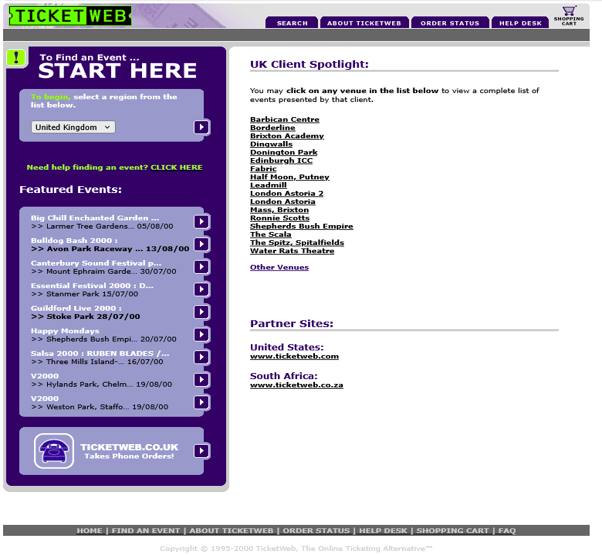
TicketWeb (UK): circa April 2000
***
2000
And just when it seemed success was inevitable ….
TicketWeb US, originally founded in 1995, had borrowed money in order to support its dramatic growth to approximately 700 clients including venues and institutions like the Bowery Ballroom, San Francisco Symphony, and San Diego Zoo (and incidentally with long complicated discussions about potentially becoming the online arm of Tessitura), as well as the UK and South African operations, and those lenders, and early-stage investors now wanted a ROI. So, the company looked around for various investment options.
Locally, preparatory meetings took place in Long Acre, London to discuss the potential ‘merger’ of TicketWeb (UK) with the US-based Tickets.com who were at the time planning to acquire Firstcall Ticketing, a London-based theatre and entertainment ticketing agency, headed up by the veteran ticketing operator Paul Burns.
But at the 11th hour, Ticketmaster Online-CitySearch acquired TicketWeb Inc. for $35.2M in an all-stock deal (Ticketmaster Buys TicketWeb In Bid to Diversify Offerings, Bruce Orwall, 30th May 2000 – https://www.wsj.com/articles/SB959636314630051866).
***
As TicketWeb (UK) co-founder and company secretary I found myself in Barcelona, attending the 2000 edition of Europe Talks Tickets, and via a legal counsel had to fax my signature on various company contracts and release forms.
Getting there involved an interesting taxi ride stuck in-between Trip Friendly III and Brian Kabatznick, two senior Ticketmaster executives and apparently new colleagues.
Which eventually led to a personal/professional journey from TicketWeb (UK) to Ticketmaster and then playing a small part in the aggregation of thirteen companies in eleven European countries, followed by the merger (‘of equals’) with Live Nation, then transactions in Spain, France, Scandinavia and the Middle East, before an eventual exit at the end of 2012.
But that really is another story.
***
Post acquisition, TicketWeb then operated as Ticketmaster’s self-service ticketing division for independent and grassroots clubs, venues and promoters working alongside, and complimenting the parent’s ticketing operations in the US, Canada and the UK.
In Australia Ticketmaster eventually acquired Moshtix (2019) to perform the same kind of function.
Without wanting to rewrite history and/or criticise anyone for their corporate short-sightedness, but there was once-upon-a-time, an opportunity offered by the possibility of the internet to re-shape the service delivery, technology and pricing of ticket retail, marketing and distribution.
In the last twenty-plus years there has been an explosion of web-based, self-serve, white-label, ticketing solutions, targeting specific genres, for example the commercial performing arts and/or the subsidised not-for-profits; the long-tail sports franchises and leagues; the meetings, conference and exhibition organisers and venues; social engagement, nighttime and event discovery platforms, as well as those specialising in the grassroots music promoters and venues, or direct-to-consumer pre-sale, ticket bundling and packaging solutions.
Not just because it personally mattered, but arguably the disruptive TicketWeb service offering, with continued infrastructural, technical and political support could have been so much more.
Not least because there are now tens of millions of tickets being processed on other ticketing platforms just in the UK.
But after twenty-five years the decision was taken to retire the TicketWeb (UK) platform and brand – arguably inevitable once the TM-CS acquisition occurred, but definitely once AMG had been migrated to the Ticketmaster platform in 2018-19, starting (of course) with the O2 Academy Brixton.
Which brings us back to the 24th November 2026, and the farewell to TicketWeb (UK) event, in Hoxton. (See Ticketmaster UK LinkedIn post: https://www.linkedin.com/posts/ticketweb-ticketmasterclubs-independentvenues-share-7531018661755748352-MTgU/).
Not even held in Brixton. Oh well.
R.I.P TicketWeb (UK).
***
Until the next time.

