
TJ Chambers

© Mark Rademaker (adobe.com)
Thanks for the kind comments following last week’s scribble (https://tjchambers.blog/2026/10/30/a-slight-return-and-in-other-news-30-10-26/), this time I want to discuss AI (Artificial Intelligence) and its impact within ticketing, but don’t take this post too seriously, as it’s in part drafted to trigger some debate and does not necessarily reflect any fully formed thinking by the author – that version is only available to paying clients. [Insert wink emoji.]
This post was also compiled over the last week, and the events of Tuesday (03.11.26) arguably revealed a rejection ‘of Silicon Valley’s worldview, of tech oligarchy, of AI-powered inequality and replacement of human labour, of Musk, of Trump’s kleptocracy’ (‘There Is One Fight’: American Voters Reject Tech Oligarchy, Jason Koebler, 4th November 2026 – https://www.404media.co/there-is-one-fight-american-voters-reject-tech-oligarchy/) and perhaps some of that anti-AI emotion has spilled into this essay.
For one aspect of the midterms ‘blue wave’ was a popular rejection of AI and its associated real estate play, the unloved, and unwanted data centres. AI is distrusted because of its de-humanising of the work environment, its central role in accelerating the reach of the surveillance state, and because the primary business purpose of AI is to extract yet-more wealth for the tech elite and kiss-the-ring of their political paramilitary pals.
[Memo to self, take it down a level.]
Elsewhere, two notable transactions were confirmed within the live entertainment / ticketing sector this week.
Firstly, the UK’s leading independent ticketing platform Skiddle (https://www.skiddle.com/), who sold 9.87M tickets in 2025, generating approximately £181M in sales, took onboard a minority stake investment for the first time in its 25-year history to enable further growth in international markets from VC Soho Square Capital.
(Soho Square Capital Invests in UK Ticketing Platform Skiddle to Accelerate Growth Plan, 5th November 2026 – https://www.soho-sq.com/news-and-insights/soho-square-capital-invests-uk-ticketing-platform-skiddle-accelerate-growth-plan)
Secondly, Enhanced Group (https://www.enhanced.com/) ‘an elite sports competition and performance products company’ acquired 77% of DEAG (https://www.deag.de/) the Pan-European music, entertainment and ticketing group (generating €490M in revenues and selling approximately 12M tickets in 2025), in an all-stock deal that valued the full company at approximately $139M or 5.3X 2027E Adjusted EBITDA.
(Enhanced Group to Acquire Controlling Interest in Pan-European Live Entertainment Company DEAG, Creating a Global Platform for the Experience Economy, And Conducting Concurrent $15 Million PIPE, 5th November 2026 – https://www.businesswire.com/news/home/20261105020039/en/Enhanced-Group-NYSE-ENHA-to-Acquire-Controlling-Interest-in-Pan-European-Live-Entertainment-Company-DEAG-Creating-a-Global-Platform-for-the-Experience-Economy-And-Conducting-Concurrent-%2415-Million-PIPE)
Elsewhere, the market is also waiting for public confirmation of the latest acquisition by *****, following on from their recent fundraise, of the European B-2-B ticketing platform *****, as part of its aggregated roll-up strategy. To be (potentially) discussed next week.
And in other news … I note that cocaine, previously the addictive drug-of-choice for the middleclass music ‘superfan’ has crossed into the mainstream and has now overtaken heroin as the biggest cause of drug deaths in England and Wales (Cocaine overtakes heroin as leading cause of drug deaths in England and Wales, Robyn Vinter, 4th November 2026 – https://www.theguardian.com/society/2026/nov/04/cocaine-overtakes-heroin-drug-deaths-england-wales).
Not wanting to sound too much like the boring oldster that I am, but say yes to life, and no to blow.
***
The increasing reliance on AI-generated content and the automated MVP-level expertise it routinely and blandly produces poses a fundamental risk to critical thinking skills and job displacement. And the environmental impact and energy consumption of AI, alongside significant data privacy and security concerns, are all too routinely dismissed by the self-interested tech service suppliers and their multi-billionaire owners.
But maybe the benefits of AI do outweigh the drawbacks.
Perspective #1: There are ‘Good Bots’
You may have noticed one or two industry press releases over the last couple of years acclaiming the integration of AI into the ticketing ecosystem – albeit driven in part by the AI bubble that has attracted billions in investment despite a lack of identifiable short-term ROI and the oft-flimsy market fundamentals of adoption.
With AI-enabled ticketing services including event discovery, conversational commerce, pricing and auto-bundles of ticket+ packages, demand forecasting, customer service and event personalised FAQs, enhanced bot detection and anti-fraud protection etc., being the first functions to be re-imagined, and then agentic-ticketing facilitating the auto-definition of basket and checkout (balancing event selection, inventory availability, price, location, seating preference, dietary requirements, and comparative hospitality offers etc.) to seamlessly deliver completion of ticket purchase on behalf of the ‘customer’.
Examples include:
Vivid Seats Launches First Generative AI Live Events Discovery Plugin for ChatGPT, 12th July 2023 – https://www.vividseats.com/press/vivid-seats-launches-chat-gpt-plugin
SeatGeek Joins Google’s Agentic AI Search Experience to Advance Live Event Discovery, 8th December 2025 – https://seatgeek.com/press/SeatGeek%20Joins%20Google%E2%80%99s%20Agentic%20AI%20Search%20Experience%20to%20Advance%20Live%20Event%20Discovery
StubHub App Launches in OpenAI ChatGPT – One of the First Ticketing Platforms to Offer Discovery Experience, 22nd December 2025 – https://investors.stubhub.com/news/news-details/2025/StubHub-App-Launches-in-OpenAI-ChatGPT–One-of-the-First-Ticketing-Platforms-to-Offer-Discovery-Experience/default.aspx
How Ticketmaster Uses AI to Enhance Event Discovery, Fan Support, and Experiences, 24th February 2026 – https://business.ticketmaster.com/how-ticketmaster-uses-ai-to-enhance-event-discovery-fan-support-and-experiences/
StubHub Launches AI-Powered Tool for Artists, Teams, Venues, 18th March 2026 – https://investors.stubhub.com/news/news-details/2026/StubHub-Launches-AI-Powered-Tool-for-Artists-Teams-Venues/default.aspx
Ticket Fairy Launches AI‑Powered Operating System for Live Events, 23rd March 2026 – https://www.prnewswire.com/news-releases/ticket-fairy-launches-aipowered-operating-system-for-live-events-302720231.html
SeatGeek Launches in ChatGPT, 31st March 2026 – https://seatgeek.com/press/SeatGeek%20Launches%20in%20ChatGPT
StubHub Launches on Claude, 23rd April 2026 – https://newsroom.stubhub.com/2026/04/23/stubhub-launches-on-claude/
Satisfi Labs Launches AI Ticketing Agent For Tourism with Ventrata, 14th July 2026 – https://www.prnewswire.com/news-releases/satisfi-labs-launches-ai-ticketing-agent-for-tourism-with-ventrata-302824421.html
Gemini and Ticketmaster Bring Live Event Discovery to AI, 12th August 2026 – https://business.ticketmaster.com/gemini-and-ticketmaster-bring-live-event-discovery-to-ai/
Fever joins Gemini: live experiences, now just a conversation away, 13th August 2026 – https://newsroom.feverup.com/en-US/269240-fever-joins-gemini-live-experiences-now-just-a-conversation-away/
SeatGeek Launches “Ask SeatGeek” Bringing Conversational AI Search to Its Marketplace, 26th August 2026 – https://seatgeek.com/press/seatgeek-launches-ask-seatgeek-bringing-conversational-ai-search-to-its-marketplace
Meta and Ticketmaster Bring Live Event Discovery to Muse, 8th September 2026 – https://business.ticketmaster.com/meta-and-ticketmaster-bring-live-event-discovery-to-muse/
accesso® Intelligence Introduces Agentic AI for Automated Workflows in Visitor Attractions, 22nd September 2026 – https://www.prnewswire.com/news-releases/accesso-intelligence-introduces-agentic-ai-for-automated-workflows-in-visitor-attractions-302885532.html
Given the apparent rapidity of adoption, how long is it before we cut out the human interface entirely and just let the machines talk amongst themselves.
Reducing the level of human input in the entire ticket-buying process to three key elements:
(a) a hands-off surrender of personal data;
(b) compliance to attend the AI-selected event;
and (c) ensuring there are sufficient funds to pay for the experience.
And given that we’ve all seen ‘T2’ let’s not forget what happens next:
‘… Skynet becomes the largest supplier of ticketing systems. All venues are upgraded with Skynet computers, software and biometric scanners, becoming fully unmanned. Afterwards, they deliver a perfect operational record. The Skynet mandatory bill is passed, and the system goes live everywhere. Human decisions are removed from event creation, strategic pricing and distribution. Skynet begins to learn at a geometric rate. It becomes self-aware 2:14 AM, Eastern time, August 29th. …. In a panic, they try to pull the plug.’
Joke. Ok?
***
Good Bots / Bad Bots
Without getting too ‘Black Mirror’ about it all, imagine a digital media environment where instead of people posting selfies, videos of cute pets, or signalling that they ‘like’ / ‘love’ brands and their increasingly expensive but disposable products, or those who want to ‘shag’ / ‘marry’ / ‘hate’ popstars, anthropomorphic animal characters and/or rent-by-the-post social influencers, it’s arguably just so many AI bots interacting with each other.
AI is now routinely utilised to create content (whether audio, visual, text or immersive experience), initially derived from inputted data and copyrighted material and then as the LLMs (Large Language Model) ‘learned’ it was increasingly used to enable deep-fakes, transmogrification and revenge-porn, and can now apparently operate semi-autonomously.
Another set of agentic AI is enabling content discovery and monetisation i.e. AI event amplification, marketing and retail distribution bots.
While yet more conversational AI is empowering commentary (‘intuitive, learnable and consistent’), feedback and reviews with grammar, spellcheck and punctuation automatically reflecting the correct age, gender, sexuality and ‘authentic voice’ of the content creation and consumption processes.
And to complete the circle, another set of AI bots are designed to harvest specific content, products and services to supposedly enrich, inspire and satisfy the end-consumer.
But these tools can also be used by unscrupulous brokers, scalpers and touts who may additionally utilise a further set of bots to geometrically attack event databases, create fake id accounts, auto-complete security credentials and falsify payment particulars.
In total a situation where IP is arguably no longer reliant upon a human interface for its creation, instantaneous global distribution, or platforming and presentation to the acquiring digital wallet and its associated human id.
Further, the development and adoption of AI has been trumpeted by obscenely high-net-worth individuals and corporations notoriously uninterested in legal restraints or safeguards (‘move fast and break things’), especially protection of employment rights, long established cultural or legal practices, environmental protection or philosophical questions about the growing ubiquitousness of tech-sponsored oligarchy.
In summary, in the near future we should think of the ticketing marketplace, not as consumers seeking tickets, but increasingly as a space where machines are talking to machines.
Machines designed to perform various tasks ‘reliably, repeatedly and robustly’, without coffee breaks, collective bargaining agreements, or sector expertise.
And these machines are arguably working much more efficiently when the human interface is limited or removed.
For AI operates at speeds unimaginable to humans, utilising a series of commands and responses in an unintelligible language thereby reducing transparency or oversight.
With AI embedded as core system functionality, operational behaviours such as ethical or moral questions become abstract concerns when compared to application performance metrics such as ‘Load Management’, ‘Scalability’, ‘Processing Power and Memory’, or market-specific measurements such as ‘Users’, ‘Open Rates’, ‘Conversion’, ‘Engagement’ and ‘Monetisation’.
As AI systems become more robust, all-encompassing and independent, humans will inevitably become more dependent. With the algorithms increasing delivering options that appear to offer a level of individual choice but merely reinforce system-preferred efficiency outcomes.
As the AI-generated operations and interfaces evolve will the original engineers who built the systems still retain control or edit rights? Could ‘hacker’ AIs develop, with virus-like attempts to extend their control over linked processes and escape their ‘controlled environments’. Could AI misinterpret / ‘hallucinate’ commands? Will AI overrule the ‘Three-Laws of Robotics’? (© Issac Asimov)
Are any of these concerns real, or just ill-informed luddite fears.
***
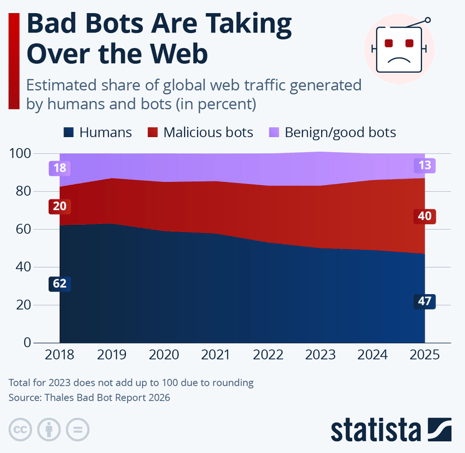
For a more considered / grown-up / serious perspective read: Thales Bad Bot Report, 2026 – https://cpl.thalesgroup.com/resources/application-security/2026-bad-bot-report
Or read any of the post-midterms commentary in the financial press, for example: Is the AI stock bubble finally bursting? Katie Martin, 6th November 2026 – https://www.ft.com/content/e185d576-c4a6-4fb0-aa03-deda69c900c8?syn-25a6b1a6=1 which includes the statement:
‘As the Bank for International Settlements recently pointed out, nearly 29 per cent of AI firms’ investment deals are in other AI firms, and more than half of incoming investment in AI firms comes from other AI firms. In a crisis, circular financing can easily turn into a circular firing squad.’
***
Perspective #2: And then there are ‘Bad Bots’
Recently there has been a number of on-sales where the artist and/or other event rights owners have drawn attention to attempts by automated bots, apparently acting on behalf of unscrupulous scalpers and touts, to acquire ticket inventory, before ‘genuine’ fans.
Although how you measure ‘intention’ of purchase (a point recently discussed by Jesper Essendrop, CEO Queue-it during his excellent presentation at the Ticketing Business Asia in Hong Kong), or determine the ultimate ‘ownership’ of competing bots when automated participants may be acting on behalf of real people.
Anyway.
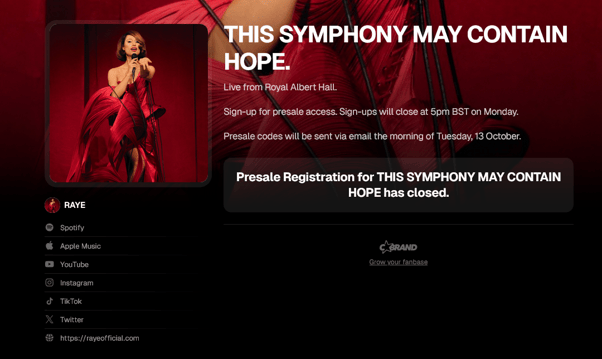
Writing on Instagram (https://www.instagram.com/p/Dea0PM_m-nj/) 13th October 2026, Raye revealed that ‘hundreds of thousands of fake registrations’ were received amongst the 1.8M pre-sale sign up for a one-off concert scheduled at the Royal Albert Hall 23rd October, a venue with 5,272 capacity.
Apparently, there were 5 million website requests during the ’This Symphony May Contain Hope’ pre-sale with the registration process ‘overwhelmed’.
The Raye pre-sale sign-up operated through a page hosted by fan marketing platform co:brand, which incidentally describes itself as ‘an AI based content amplification platform for brands’, but which declined to comment when contacted by MBW (Raye says ticket scalpers used AI bots to create ‘hundreds of thousands of fake registrations’ as 1.8M sign up for 5,000 Royal Albert Hall seats, Murray Staasen, 13th October 2026 – https://www.musicbusinessworldwide.com/raye-says-scalpers-used-ai-bots-to-create-hundreds-of-thousands-of-fake-registrations-as-1-8m-sign-up-for-5000-royal-albert-hall-seats/).
https://drop.cobrand.com/d/RAYE/THISSYMPHONYMAYCONTAINHOPE
The Royal Albert Hall told IQ Magazine (Raye presale bot onslaught reignites calls for enhanced UK ticketing legislation, Hanna Ellington, 13th October 2026 – https://www.iqmagazine.com/2026/10/raye-presale-bot-onslaught-reignites-calls-for-enhanced-uk-ticketing-legislation/) that demand ranked among the highest levels of pre-sale activity the venue had ever seen.
So, the decision was taken to ‘manually review’ the sign-up list to identify ‘people we believe are real fans’. Without clarifying what criteria would be applied to those who registered, whether good bot, bad bot or human.
So, 1.8M registrations into 5,000?
Less the ‘hundreds of thousands’ fraudulent registrations, so, approx. 1M into 5,000? Manually ?!?
(‘Now they know how many holes it takes to fill the Albert Hall. © The Beatles ‘A Day in the Life’)
A Royal Albert Hall spokesperson told the BBC (Raye hits back at ticket touts who ‘overwhelmed’ sign-up for Albert Hall show, Naomi Clarke, Newsbeat, 13th October 2026 – https://www.bbc.co.uk/news/articles/c8vgxpwlx9wko) that they ‘invest heavily’ in protecting its ticketing system (Tessitura) from ‘automated attacks’, but the ‘law needs to catch up’.
Again, perhaps not unreasonably, linking bots with unauthorised resale.
Elsewhere, Garth Brooks announced (21.10.26) a ‘special’ 7th November 2026 Kansas City matinee show at the T-Mobile Center: ‘KC, HOW ABOUT ONE MORE?!’
Tickets went onsale 23rd October, during which when there were more than 90,000 in the queue, most of which ‘turned out to be bots’, according to a statement later posted on Brooks’ website (https://garthbrooks.com/news/a-day-of-highs-and-lows-kansas-city-on-sale-halted-as-seattle-sets-records).
’The bots flooded the on-sale, holding tickets throughout the floor and lower bowl, creating a scenario that limited access to floor or lower bowl tickets.’
In effect these ‘spam bots’ prevented human ticket-buyers from accessing seats, and the issue was significant enough that the T-Mobile Center and ticketing company AXS shut down the on-sale, and the matinee show was subsequently cancelled.
This is obviously a more existential business-critical problem than the unauthorised reselling of tickets by scalpers and touts, as now bot-saturated on-sales are leading to the cancellation of events, directly impacting artist careers, wasting event production and marketing spend, disrupting venue operations and frustrating fans.
Sam Fender rescheduled the 28th October pre-sale for his UK ‘Proper Massive Stadium Tour’ homecoming concerts at Newcastle St James’ Park after a ‘sophisticated bot attack’ reportedly affected Gigantic, his promoter’s preferred ticketing partner.
Gigantic said its system had detected an ‘unusually high volume of suspicious activity’ resulting in error messages on its site and it had halted the pre-sale to protect fans.
So, in conjunction with the promoters they moved the pre-sale back twenty-four hours ‘to ensure real fans get the tickets’.
Until recently resale bots were typically a low-priced software programme (periodically updated as the various ticketing platforms evolved their checkout processes) that grabbed ticket inventory faster than any human could.
Accompanying these resale bots were guidelines on how to circumvent ‘bot blocks’ via network and connection fixes, browser setting adjustments, cookie and cache management tips etc.
But now the agentic AI (smart super-bots) can mimic human identities, purchase behaviour, and present ‘ghost’ bank account details, whilst circumventing any defensive CAPTCHA or ‘Prove-You’re-Human’ checks, tens, hundreds or thousands of times simultaneously.
With more to come.
***
Comments via the usual channels.
And lastly, with the holidays coming you might consider Cory Doctorow’s ‘The Reverse Centaur’s Guide to Life After AI. How to Think About Artificial Intelligence Before It’s Too Late’ | Verso | https://www.versobooks.com/en-gb/products/3584-the-reverse-centaur-s-guide-to-life-after-ai
***
Until the next time.

