
TJ Chambers

(c) dreamstime.com
This week in-between speaking with a ticketing start-up founded by a digital nomad but now based in London, an East European coding and system supplier to ticketing marketplaces, a new UK-based ticket-insurance solution, and answering various enquiries from pre-existing clients, I attended Event Tech Live (https://eventtechlive.com/) at London’s ExCel, the event tech and marketing solutions fair with its bewildering collection of registration, badging, biometrics verification, content creation, messaging, mobile apps, real-time language translation, social engagement and data manipulation technology suppliers.
Many of them apparently now improved with the addition of AI.
The sales pitch of these platforms all stressed the added value of artificial intelligence to the effectiveness of their solution – faster, smarter, and seemingly more flexible to evolving business needs, with the implicit suggestion that junior level operators could now become low-cost but professional level creators, data scientists and supremely qualified marketing geniuses / genii.
At times the confident and shiny point-of-sale was reminiscent of claims made by previous apostles of NFTs, Crypto, Blockchain, the Metaverse etc. And possibly like those health, nutrition, haircare or erectile dysfunctional supplements typically advertised on mid-afternoon / late-night TV, they should all be accompanied with a disclaimer banner that runs across the bottom of the screen.
Moving on.
***
Touts gonna tout …
Elsewhere. The U.S. Securities Exchange Act of 1934 requires public companies file a quarterly report with the Securities and Exchange Commission (SEC). This report, aka Form 10-Q, includes financial information and other performance data, together with management-drafted commentary.
Every 90-days.
Which means that companies learn to say little of substance for fear of ‘spooking the market’, industry observers, and/or shareholders, unless announcing specific examples of record revenues, big client wins, or overcoming a regulatory hurdle that previously restricted its relentless expansion into another market.
The 10-Qs are written in a resolutely neutral, bland but upbeat, language that says as little as possible but implies all is good. And is always accompanied by a forward-looking statement disclaimer which explains that projections and plans are based on current but an evolving set of assumptions, are subject to known and unknown risks and uncertainties, and are not guarantees of future results.
Anyway, public companies in the live entertainment sector now include a couple of secondary ticketing marketplaces: StubHub Holdings Inc. (https://www.stubhub.com/), and VividSeats Inc. (https://www.vividseats.com/).
Other US secondary operators, for example GameTime (https://gametime.co/), SeatGeek (https://seatgeek.com/), SITickets (https://www.sitickets.com/), TicketNetwork (https://www.ticketnetwork.com/), and TickPick (https://www.tickpick.com/) are privately held companies, and/or venture capital backed, and do not trade on public stock exchanges.
The main business model of these secondary marketplaces is to connect demand for ticket inventory, where it exceeds supply, and there is a speculative margin to be, in part or fully extracted by the platform.
An example of the latter is when the owner of the secondary marketplace is also the ticket seller as is alleged in the ongoing ‘deceptive practises’ lawsuit, and Congressional ‘collusion’ investigation (https://oversightdemocrats.house.gov/imo/media/doc/2026-10-22garciatoericbakerandrorestubhub.pdf), which identifies Eric Baker, CEO StubHub, whilst also the MD of Andro Capital, a hedge fund that profits from the buying and selling tickets on the secondary market, and is also linked with a commercial affiliate Colloquy Capital, who with Andro Capital enabled the sale of millions of dollars of tickets via StubHub at preferential rates. Again, allegedly.
Secondary, the rise …
As previously discussed, the internet enabled ‘disruptive’ brokers, scalpers and touts to geometrically extend their mercantile reach beyond the walk-up of events, with the arbitrage margins fuelling enhanced search engine placement, alongside fiscal inducements to some inventory rights owners, to effectively compete for consumers unaware of face-value pricing, late availability offers, or ‘official’ ticketing offered by the primary agencies and outlets.
The secondary operators often unauthorised by many of the original events rights’ owners (the artist, attraction, sports franchise, promoter, producer, venue, etc.) – in part due to concerns about profiteering whilst having no shared risk with event creation – concentrated their efforts on sourcing, or at times ‘speculatively’ listing (now technically illegal) tickets, with their much-trumpeted 100% refund offers if customers were unable to actually attend with their resold goods.
Primary, the reaction …
Anyway, time passed and the primary ticketing platforms responded with a more sophisticated offering with a sector-wide adoption of yield management strategies, or ‘Ticketing Product’ differentiation.
Pricing-by-Date: Mid-Week Vs Weekend
Pricing-by-Location: Stalls Vs. Balcony, ’Meet & Greet’, SoundcheckTix, Festival ‘Golden Circle’, Capital Vs. Regional dates
Pricing-by-Product: Ticket Bundles + Packaging, VIP + Hospitality
Pricing-by-Timing: Early-Bird and/or Standby Pricing, Late-Sale Discounting, Walk-Up Premium
Variable Scaling: i.e. changing the configuration of an event auditorium between performances
Ticket Inventory Management; i.e. ‘slow ticketing’. Drip-feeding the amount of inventory available via adding shows or increasing allocations whilst ensuring ‘Demand (always) exceeds (available) Supply’. Can lead to fan / social media scare over unsold events and/or opaque ticket distribution policies
Demand (Surge) Pricing: flexible prices for tickets based on comparative (Secondary) market-pricing e.g. Ticketmaster’s ‘Platinum Tickets’. Albeit can lead to perception that Artists are ‘scalping’ own fans
Towards a single ticketing marketplace
The primary market now typically (and oft lazily) anchors its demand-pricing around comparative secondary market benchmarking, with the rationale that it’s better that the artist / artform / performers / attraction, aka event rights owners, receive the increased gross transactional value (GTV) than it go to unauthorised speculators.
Or more cynically, they’re fine with the artist gouging their own fans, as opposed to the touts.
So, the primary market is increasingly eating the secondary’s lunch, and the operational difference between many ticketing operators is dissolving, with the formation of a single ticketing marketplace and with inventory always available, across multiple platforms, albeit at a price.
And this is arguably having an impact on the stock valuations of the leading, publicly traded secondary marketplaces, as they are forced to compete against the ongoing cultural distaste for unauthorised resale, the growth of ‘ethical’ resale platforms (for example CashorTrade (https://cashortrade.org/), Menta Tech (https://www.mentatech.io/), TicketSwap (https://www.ticketswap.com/), Tixel (https://tixel.com/au/), Twickets (https://www.twickets.live/en/uk) etc.), the development of primary market ticket exchange and/or resale facilities (for example AXS Official Resale, Eventim fanSALE, Ticketmaster Resale and others), alongside the growing international regulatory restrictions on crude free-market behaviours.
In combination, primary ticketing is increasingly disrupting the once-disruptive secondary ticketing market, and this shift is significant as it affects the market share and thus profitability of pure-play secondary platforms.
StubHub Holdings Inc.
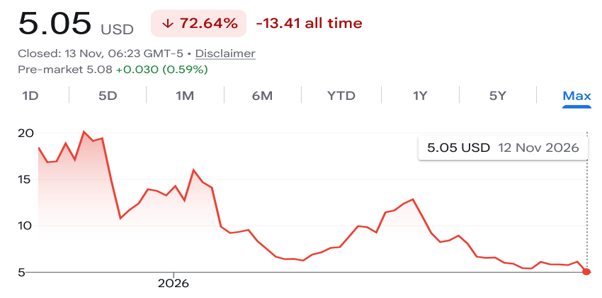
(c) Google (12.11.26)
Vivid Seats Inc.
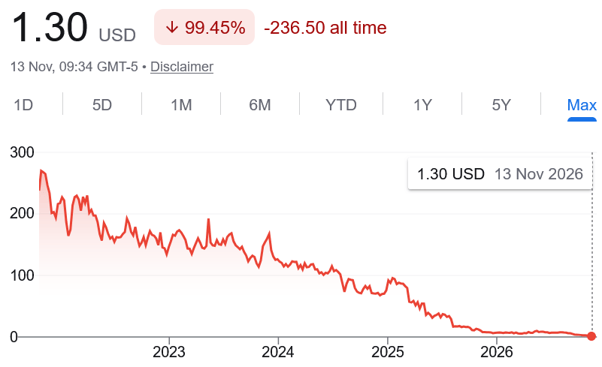
(c) Google (13.11.26)
***
Industry observers and commentators have noted this reversal of overall market dynamics, with the strengthening of ticket retail options by the formerly primary-only players with a resultant change of (where, with, whom and how) consumer behaviour, and the impact on secondary revenues, the increased strain on their debt repayment, whilst accompanied by the relentless pressure of regulatory investigations and lawsuits.
But a closer analysis of these two operators does reveal does some differences.
For example, in the last quarter StubHub (‘the global destination for consumers to access live entertainment experiences’) is reporting revenues up 7% on the same period in the previous year (StubHub Quarterly Report, Form 10-Q, 12th November 2026 – https://d18rn0p25nwr6d.cloudfront.net/CIK-0001337634/a808bf1e-a7ae-4590-ba9e-897733566532.pdf), whilst VividSeats is only up 1% (Vivid Seats Quarterly report, Form 10-Q, 9th November 2026 – https://investors.vividseats.com/static-files/3eeb590a-f36b-460b-bfe8-f2c14588b296).
As noted by industry maven Dave Brooks (Two Resale Giants, Two Very Different Balance Sheets, Dave Brooks, 11th November 2026 – https://decibel.news/p/two-resale-giants-two-very-different-balance-sheets):
‘StubHub is making real money. It keeps about a quarter of its revenue as operating profit, it has more than a billion dollars in the bank, and it has paid down a big chunk of its debt this year. Vivid Seats is a different story. It’s selling fewer tickets than a year ago, its cash has been cut in half since January, and investors who trade its debt are treating that debt as if they may not get all their money back.’
But that is only part of the story.
As noted by Eric Fisher there is a great deal of dissatisfaction with these publicly traded ticket resellers, despite demand for live sports (the main driver of resale inventory) including the recent FIFA World Cup continuing to maintain market highs (Ticket Resellers StubHub, Vivid Seats Give Dismal Earnings Reports, Eric Fisher, 10th November 2026 – https://frontofficesports.com/article/ticket-resellers-stubhub-vivid-seats-give-dismal-earnings-reports/).
As detailed within the article, StubHub came to the market with an $8.6Bn valuation but is now trading with an implied market capitalization of approximately $2.2Bn.
Similarly, VividSeats when it went public in 2021 was worth approximately $2Bn but its current market capitalisation stands at less than $17M and remains unprofitable.
But before you shed any tears, the re-invention of ticketing platforms works both ways.
For example, SeatGeek offers a sophisticated B-2-B ticketing, box office and ticket pricing solution – collectively SeatGeek Enterprise – to sports franchises and venues as well as its secondary ticketing retail and distribution platform.
And StubHub is actively pursuing ‘direct issuance’ relationships with event rights owners to offer an incremental retail marketing and distribution channel.
A recent example of which is Seatly (https://www.seatlytickets.co.uk/) which aggregates ‘Face-Value UK Football Tickets Direct from the Clubs’.
Seatly / StubHub claims that ‘match tickets sourced directly from clubs at face value’ but ‘Seatly is not a secondary marketplace. Fans cannot list tickets on Seatly at inflated prices, and there are no resale markups.’ Further that ‘Seatly will be customer-centric, with no extortionate fees.’
For further details: Seatly – seatlytickets.co.uk launched by StubHub: Face-Value UK Football Tickets Direct From the Clubs, 22nd October 2026 – https://www.einpresswire.com/article/951586813/seatly-seatlytickets-co-uk-launched-by-stubhub-face-value-uk-football-tickets-direct-from-the-clubs
With more presumably to follow.
So Primary > Secondary, and vice versa.
***
And in other news …. highly recommended.
‘Gouged. The End of a Fair Price and What That Means for Your Wallet’, Lindsay Owens – https://gougedbook.com/
‘Gouged takes readers inside the corporate boardrooms and backrooms where pricing decisions are made and exposes the mechanics behind practices that are growing ubiquitous across the economy: dynamic and algorithmic pricing, surveillance-based price discrimination, hidden fees, and dark patterns — the manipulative design tricks that steer consumers into paying more than they intended or signing up for subscriptions they never wanted.’ (https://groundworkcollaborative.org/news/new-book-gouged-blows-open-the-high-tech-corporate-pricing-playbook-draining-americans-wallets/)
Until the next time.

