TJ Chambers

On Tuesday 17th December 2024, the FTC (Federal Trade Commission) announced (https://www.ftc.gov/news-events/news/press-releases/2024/12/federal-trade-commission-announces-bipartisan-rule-banning-junk-ticket-hotel-fees) a bipartisan Junk Fees Rule (taking effect April 2025), which requires live ticket events, hotels and vacation rentals to be transparent in pricing instead of tacking on convenience and other service fees at the end of a purchase.
This doesn’t mean that the practice of drip-pricing / bait-and-switch / junk fees will disappear, but instead it requires ‘that businesses clearly and conspicuously disclose the true total price inclusive of all mandatory fees whenever they offer, display, or advertise any price of live-event tickets or short-term lodging’.
FTC Chair Lina Khan further stated, ‘People deserve to know up front what they’re being asked to pay — without worrying that they’ll later be saddled with mysterious fees that they haven’t budgeted for and can’t avoid’.
So, for consumers the overall purchase price would effectively be the same, but the FTC estimates that they will save up to 53 million hours per year currently wasted trying to discern the total price for concert tickets and short-term lodgings.
Prior to the FTC ruling, some U.S. states including Maryland and Minnesota had already adopted all-in pricing requirements – https://www.rollingstone.com/music/music-news/maryland-concert-ticket-bill-signed-1235017908/.
Within the live entertainment business there had also been support for ‘all-in’ ticket pricing, but preferably as required by government regulation, as that would remove any competitive advantage over the presentation of event ticket prices by those not supporting the initiative.
Following comments from President Biden last year Live Nation, SeatGeek and TickPick had all previously pledged to adopt all-in prices – https://www.rollingstone.com/music/music-news/live-nation-ticketmaster-junk-fees-biden-white-house-1234772174/ – and following the FTC’s announcement Live Nation quickly re-affirmed their commitment – https://www.livenationentertainment.com/2024/12/live-nation-entertainment-supports-ftcs-push-on-all-in-pricing/.
As previously reported by Pollstar (All-In Pricing Swells Ticket Sales, Live Nation Says – J.R. Lind: https://news.pollstar.com/2024/05/14/all-in-pricing-swells-ticket-sales-live-nation-says/) Live Nation confirmed that a six-months experiment with all-in pricing had increased its ticket sales by 8%. Which arguably explains their support.
Again, to be clear, this ruling doesn’t ban U.S. live entertainment operators from charging per ticket services fees, per transaction processing fees, and/or venue facility fees etc., rather it requires the full cost of the ticket transaction be provided to customers at the beginning of the purchase process, and there be no unexpected additional charges then presented.
Lastly, the FTC commissioners voted 4–1 in favour of this new rule with Andrew Ferguson (who President-elect Donald Trump has picked as the next FTC chair), casting the sole nay vote. In his dissenting statement, Ferguson said that his problem was less with the new rule itself, and more with it being brought in by the Biden-Harris administration in its final months.
***
In other U.S. ticketing news, the lobby group Fix The Tix (https://www.nivassoc.org/fixthetix) representing a coalition of more than thirty live music and event industry organizations, spearheaded by the National Independent Venue Association (https://www.nivassoc.org/) and Eventbrite (https://www.eventbrite.com/) called for the removal of the TICKET Act from the Continuing Resolution (the temporary spending bill that keeps federal government operations going when final appropriations have not been approved by Congress and the President) unless some ‘dangerous loopholes’ were removed.
Stephen Parker, Executive director of NIVA claims that ‘disinformation from multi-billion dollar resale platforms and the organisations they fund – claiming to represent consumers’ interests – misled Congress into including a loophole that allows predatory brokers and resale platforms to sell fake tickets under a different name’.
The statement continues that these resale platforms ‘also prevented so many more common-sense reforms from making it into the final legislation, especially strengthening the BOTS Act.’ (https://www.nivassoc.org/statements/2024/a-statement-from-niva-on-the-inclusion-of-the-ticket-act-in-the-continuing-resolution).
Stuart Dredge in MusicAlly noted: Fix The Tix is unhappy that the bill in its current form doesn’t crack down on ‘concierge’ or ‘seat saver’ services, which it says “masquerade as legitimate offerings but in reality sell nothing more than empty promises to obtain tickets later – often at inflated prices” (https://musically.com/2024/12/18/us-ticketing-update-ftc-junk-fees-ban-and-ticket-act-criticism/).
Ethan Millman in Rolling Stone further revealed that some of the Act’s language helps encourage speculative ticketing – ‘Those tickets are often listed on resale sites like StubHub and Vivid Seats as “zone seats” where the specific seat number isn’t listed. If they don’t secure the ticket, the fan is refunded. At best, fans are buying tickets from scalpers at an upcharge who beat them to get seats in the first place. At worst, they can’t get into the venue, wasting time and money on any travel for the show’ (https://www.rollingstone.com/music/music-news/congress-funding-bill-ticket-scalpers-music-1235209904/).
No doubt, more to follow.
***
The Future of Music Coalition (https://www.futureofmusic.org/) a U.S. advocacy group for musicians produced the graphic below as an easy explainer of their position on the ticketing-related news: ‘On junk fees, nothing that allows StubHub or Ticketmaster to hide itemized fees till checkout, or behind a drop down menu is good enough to protect fans and artists’.
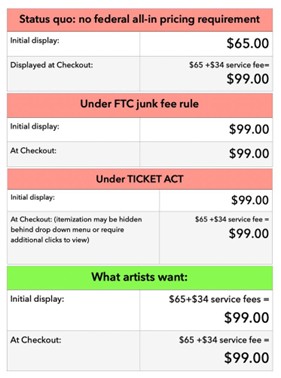
(c) Future of Music Coalition / BlueSky
Two unintended consequences of the debate surrounding junk-fees and all-in pricing is firstly that future pricing-negotiations between the Artist / Attraction / Star (together with their Management & Live Agent) and the live event Promoter-Producer / Sports Franchise may have to more fully consider the impact of the various incremental charges on the final purchase price – and the consumer willingness to continue to pay ever-higher prices for their tickets.
As noted by Neil Shah (Wall Street Journal ) and then reposted by someone.

(c) Neil Shah / BlueSky
And secondly, will the up-front consumer-facing profile (with associated government review to ensure compliance?) of the various ‘convenience’ fees at the beginning of the ticket purchase process lead to a renewed industry debate and/or re-negotiation over the frequency and scale of ticket processing fees and/or venue restoration / facility fees etc.
Presumably not as these are routinely baked into operators P&L’s and viewed by the industry as necessary and underpinned by the belief that ultimately the consumer will pay.
With (yet) more to follow.
***
Given the impending seasonal break, I wish all readers the very best. Do enjoy the time with your families and friends and we’ll catch up again in 2025.
***
 TJ_Chambers