TJ Chambers
Algorithms, and a Bonfire of the Vanities

Whilst not a qualified data scientist, experienced advertising agent, or promotions and marketing specialist, so ultimately just another semi-informed e-commerce practitioner, I find it both interesting and necessary to network and converse with sector experts, attend multi-disciplinary conferences, and to undertake independent research.
Which is a circuitous way of saying, to improve my understanding of the industry I primarily work within, I spend a fair amount of time asking questions, trying to understand the answers, and reading.
Reviewing materials from differing voices and across multiple media including blog posts, podcasts, newsletters and articles sourced from various international media, news aggregators and thought leaders (with current examples ranging from Grace Blakeley (https://graceblakeley.co.uk/), Entertainment Strategy Guy (https://entertainment.substack.com/), Cherie Hu (https://www.waterandmusic.com/), Lucas Shaw (https://www.bloomberg.com/screentime), Matt Stoller (https://substack.com/@mattstoller), and Dave Wakeman (https://davewakeman.com/)) all helping to (part) satisfy my curiosity (the who/what/where/when/why/how) of matters relating to ticketing finance, live entertainment, music, politics and technology.
Not just concerned with the compare/contrast of differing ticketing solutions, the youthful proclamations from would-be ‘disruptive’ new entrants, or the typically disdainful attitude that retail solutions routinely exhibit towards consumers whilst slavishly supporting their inventory providers.
But more interested in the evolving nature of the industry and the development of business and cultural practices, regulations, and technologies, sometimes developed elsewhere but then having an impact within ticketing.
So, algorithms.

Algorithms operate in the digital environment, vastly different from the old school media of broadcast, print, or radio, where editorial and/or content was historically provided within wraparound product advertising and sponsorship.
Those commercial or public service (government-funded) platforms, also acted as cultural gatekeepers and arbiters of popular taste, albeit with a one-sided conversation and little insight as to how individuals interpreted the messages.
Now, with the automated creep of machine-guidance embedded within a slick UX, algorithms have largely replaced the impact or influence of any individual critical review(s), or collective word-of-mouth commentary.
Instead of which, algorithms are designed to work in conjunction with product retailers or service providers, and their associated advertising spend, to ‘assist’ consumers with an engineered curation.
Essentially, algorithms are engineered to empower continual and increasingly unthinking consumption, whilst the adware software platforms attempt to present the technology with a positive veneer of a slick, and seemingly intuitive, but illusionary consumer choice.
***
Why is this important to ticketing?
Couple of reasons, all algorithms have in-built biases. Further, they are designed by and on behalf of clients and their inventory distributors, and ultimately their use within ticketing is designed to maximise event grosses.
Increasingly, surveillance-based digital advertising and targeted marketing campaigns are informing the personalised content recommendations, with funnelled event discovery / ticket search facilities to provide data-driven results which don’t present neutrally, but rather guide consumers towards client-preferred product availability.
The artificial intelligence ‘learns’ from these auto-curated purchases and utilises this data to then guide future search enquiries, which reinforces the self-fulfilling notion that what is being popularly presented / recommended is what is correct or even desired by the end consumer.
Ultimately the AI systems are designed towards more-of-the-same or close-proximity product substitutions that retains high user satisfaction scores, improves propensity to purchase, and ensures retention of the inventory provider.
The trick is to make the consumer believe they are consciously choosing the product or service. That they are not being electronically funnelled towards a packaged or formulaic cultural purchase.
To mask any understanding that risk for the event promoter-producer or ticket retailer is being programmed out of the retail process, and that audience tastes, behaviours, and emotions are increasingly being triggered by computer software.

With code increasingly influencing not just what culture we consume, but also what culture is produced.
For example, analysis of current pop music reveals songs are getting shorter, with the traditional song structure (verse-chorus-verse-chorus-bridge-chorus) now routinely disrupted by starting with the formulaic chorus enabling immediate identification by listeners.
‘On platforms like Spotify, artists earn royalties only if a listener stays engaged for at least 30 seconds, making songs with shorter intros and instantly engaging hooks dominant as it ensures that listeners don’t skip on to the next’ – Szu Yu Chen ‘Pop songs are getting shorter in the era of streaming and TikTok’ (https://www.washingtonpost.com/entertainment/interactive/2024/shorter-songs-again/).
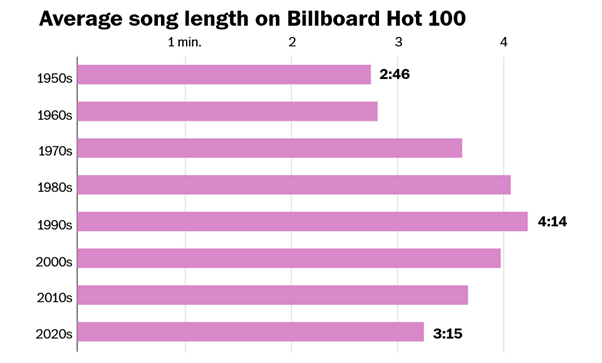
© Washington Post / Billboard
Songs built by songwriting committees, designed for streaming platforms and their playlists, and often accompanied by bite-sized videos featuring air-brushed teens with sharp haircuts, and synchronised dance moves, ideal for repeat plays on social media apps.
The data from algorithmic engagement is driving the design of the cultural content, and that consumers are subconsciously and passively adopting this new world. When ‘attention becomes the only metric by which culture is judged, and what gets attention is dictated by equations developed by Silicon Valley engineers.‘
Or at least that’s the point of view of Kyle Chayka (‘Filterworld: How Algorithms Flattened Culture’ (Doubleday) https://www.kylechayka.com/filterworld).
And without individual taste, informed by listening, experimenting, being bored and/or excited, then it’s just machine-inspired FOMO and algorithm-driven consumption.
See also Spotify’s former ‘Data Alchemist’ Glenn McDonald (‘You Have Not Yet Heard Your Favourite Song. How Streaming Changes Music’ (Canbury Press) https://www.canburypress.com/products/you-have-not-yet-heard-your-favourite-song) for more on algorithmic recommender systems – ‘algorithms and personalisation have … made their way into virtually all features of all major music-streaming services, and since the services now mostly have the same available music, similar features and similarly-priced subscription plans, algorithms are the main point of competition.’
***
On unrelated news, on 5th November 1605, there was the unsuccessful Gunpowder Treason Plot to blow up the House of Lords during the State Opening of Parliament.
The incident has been remembered ever since with Guy Fawkes Night and the burning of bonfires and fireworks displays across the UK.
One of Kent’s most famous and ticketed bonfire celebrations at Edenbridge (https://www.edenbridgebonfire.co.uk/) this year featured an effigy of Ticketmaster and the ‘puppet’ Gallagher brothers of Oasis.
As gleefully reported by the BBC (https://www.bbc.co.uk/news/articles/crez74ll9j8o), ITV (https://www.itv.com/news/meridian/2024-10-30/bonfire-society-reveals-its-infamous-celebrity-guy-as-ticketmaster), Sky News (https://news.sky.com/story/oasis-and-ticketmaster-effigy-burned-at-edenbridge-bonfire-night-13247303) and many others, few ticketing companies can achieve this level of brand awareness.

© Jack Taylor/Getty Images
***
Until next time.
***
 TJ_Chambers