TJ Chambers
The following is a repost of an article originally published by Ticketing Business News (21st November 2024).
Thanks to Ian Nuttall and the TBNews team for their support.
***
It’s not your money honey! SPECIAL: Following the Lyte’s demise, industry expert Tim Chambers believes there will be more casualties to follow – especially among those service providers which (mistakenly) present the value of tickets sold on their platform as ‘their revenues’…
***
Viewpoint: Show Me The Money!
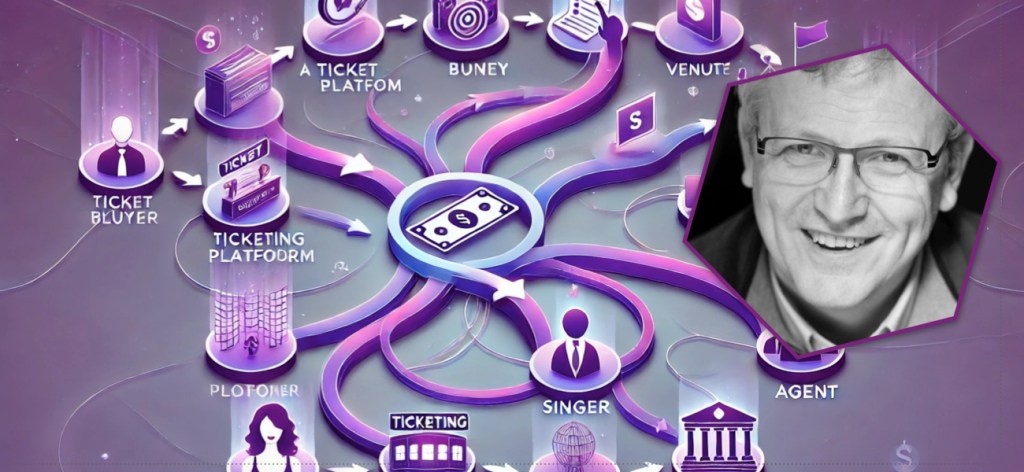
Following the Lyte’s demise, industry consultant Tim Chambers believes there will be more casualties to follow – especially among those service providers which (mistakenly) present the value of tickets sold on their platform as ‘their revenues’…
The debate concerning the fiscal robustness of some operators within the live entertainment ticketing sector was re-ignited in recent weeks following the apparent shutdown and suspension of services by Lyte (https://www.theticketingbusiness.com/2024/09/18/lyte-ceo-departed-weeks-before-company-shut-down/).
The question being asked, once again, following on from other notable failures at Pollen (https://www.theticketingbusiness.com/2022/10/25/pollen-owed-almost-80m-at-time-of-collapse/) and Festicket (https://www.theticketingbusiness.com/2022/10/19/festicket-owed-more-than-22-5m-at-time-of-collapse/) is simply: How does an organisation that routinely receives payment for goods in advance of consumption, go bust?
Specifically, what are the market circumstances that cause these service providers to fall into liquidation. Are they simply unlucky and unrelated failures, or are they reflective of their managements’ inability to cope with the infrastructural economics of ticketing?
WHAT’S THE OFFER NEWCO?
Whether D-2-C, B-2-B or B-2-C ticketing solution suppliers all offer event Rights Owners (e.g. Artist, Attraction, Promoter-Producer, Sports Franchise, Venue, Media Partner, Affiliate or Sponsor etc.) aka the ticket inventory provider, fundamentally similar technologies enabling:
- event manifest management;
- data acquisition;
- the externalisation of event customer services;
- the incremental retail, multi-branded marketing and ticketing distribution; and
- increasingly significant pre-event maturity cashflow including full or partial retention of ticket transactional margin.
FOLLOWING THE FLOW
To understand the financing of the ticketing sector it’s important to appreciate the industry’s political landscape and historically-developed practices within its ecosystem.
Essentially, the Artist (with their Management and Live Agent) in conjunction with the Promoter-Producer set the Ticket prices and agree the Artist Fee (typically including Guarantee and/or Percentage Break), event budget, production and top-tier marketing strategies.
A deposit of up to 50% of the Guarantee may be paid by the Promoter-Producer to the Artist at time of exchange of contract with 100% of the Fee due by the event maturity.

Approximately 3-6-18 months elapses between the initial Artist-Promoter agreement and the first date performed under that contract.
Within the international territories, Promoters typically direct the marketing of events, distribute Ticket rights, rent or otherwise provide venues, or greenfield sites for festivals, and arrange for production services e.g. Staging, Power, Lighting, Crew, Event Security, Tour Logistics and Catering etc.
Venue operators typically contract with the Promoters to rent their premises for specific events on specific dates and receive fixed fees and/or a percentage of Ticket allocations and revenues as rental income.
Additionally, Venue operators can provide services such as Concessions, Parking, Security, Ushers and Ticket-Scanning and may receive part/all of the revenue from Concessions, Merchandise, Venue Restoration Fees, Venue Sponsorship, Parking, VIP and Premium Seating.
“The market expects consumers to acquire tickets weeks, months or years in advance with little right to exchange and/or refund”
Ticketing service providers enable the sale of Tickets primarily online but also through mobile devices, box office channels, outlets and 3rd Party affiliates providing incremental retail, marketing and distribution, albeit by adding an incremental charge in the form of per Ticket service fees and/or per Transaction processing fees.
And for the Consumer, the Fan, Patron, the Spectator or Supporter?
The market expectation is that they will acquire tickets weeks, months or years in advance with little right to exchange and/or refund – arguably a form of non-returnable deposit rather than an equitable consumer proposition. And the ticketing industry’s answer to this service inflexibility is the promotion of Event Cancellation / Ticket Insurance – so that the consumer pays, again, for their additional protection.
WHO’S GOT MY MONEY?
The live entertainment industry cashflow requirements, mean that the ticketing proceeds are collected from the consumer and initially held by the ticketing service provider.
B-2-C retail agencies typically then retain a percentage of the fees accrued per Ticket sold, either calculated as an inside commission charged to the event Rights Owner, or more typically charged onto the consumer as service fees.
They may also retain a proportion of any per Transaction fees.
B-2-B service providers typically receive a per ticket processing license fee with product service upgrades, maintenance and hardware sales as incremental revenue opportunities.
The industry expectation is that the B-2-C retail agency advances a proportion of ticketing receipts to the event Rights Owners either on a rolling weekly basis (subject to some form of Reps & Warranties) or will undertake a rudimentary (‘domino-theory’) risk analysis offsetting any advance from one concert/tour/festival against the balance of other events onsale but not yet matured.
Additionally, as it’s a supply-side orientated industry, B-2-C operators are increasingly paying higher than ever rebates, commissions, and/or marketing contributions (‘kickbacks’) to event Rights Owners in order to attract and/or maintain inventory acquisition, and/or grow market share.
The presence and indeed growth of B-2-B solutions in the sector is in part because event Promoter-Producers as well as Venues are increasingly seeking earlier, or full access to advance funds, and so utilise 3rd Party payment processing to more readily access ticketing revenues.
ESCROW (OR OPERATING) FUNDS?
Whether any these organisations should be mingling advance ticket sales, traditionally held in consumer escrow accounts (to ensure funds are available to resolve any customer issues regarding rescheduled and/or cancelled events) with corporate operational funds is one obvious area of concern.
“Whether these organisations should be mingling advance ticket sales – traditionally held in consumer escrow accounts – with their corporate ‘operating’ funds is one obvious area of concern”
Essentially, the ticketing ecosystem is taking ‘free-money’ in the form of advance ticket purchases from consumers to support the event Rights Owners’ and their associated service partners ongoing business operations.
Underpinning this fiscal model of ‘the future funding now’ where the consumer is unknowingly the Bank / LOLR (Lender of Last Resort) for the sector, is the belief that most events will occur (especially within sports where the fixture may be rescheduled but where the match will inevitably take place).
This is fine until you have a sector-wide shutdown – as occurred with the pandemic – when instead of automatic refunds, the live entertainment industry offered multiple rescheduling of events, or appealed to consumers to accept gift tokens or convert purchases into donations to the ‘arts’ organisation.
Arguably they offer anything other than giving back the money, especially as the various event Rights Owners and their partners – or indeed the ticketing service providers – may have already spent it.
***
For the ticket platforms and solution providers, as ticketing has become more technically complex – developing from General Admission, Seat-Row-Block/Best Available/Select-A-Seat, and Timed Admission protocols, to encompass and/or ‘Middleware’ integrate with Access Control, CRM (Customer Relationship Management) + Data Analysis, POS (Point-of-Sale) alongside Anti-Bots, Identity Verification, Payments Processing, Queuing Technologies, ever-slicker UX, etc. as well as providing multi-branded, multi-channel incremental retail, marketing and distribution of ticket inventory – the (B-2-B) ticket licence fee, or the (B-2-C) ticket retail margin in a massively commoditised sector has in real-terms diminished.
Essentially, ticketing service providers are having to provide more. More technology, services and fiscal incentives to compete against others always willing to offer their solution for 1p-less-per-unit.
Which is why the most recent ticketing service initiatives are increasingly designed to improve overall fiscal margins i.e. Bundling + Packaging (taking margin from the Tourism and Hospitality sectors) and the utilisation of Yield Management Tools e.g. In-Demand / Surge Pricing.
FUELLING GROWTH OR PROMISES
In conclusion, new entrants to the ticketing sector typically emphasise their platform’s operational simplicity, increased efficiency, genre or territorial expertise, or that their accretive engineering (whether call centre, online, mobile, retail outlets, kiosks, affiliate distribution etc.), or their democratization of ticketing (connecting artists directly to audiences removing the need for intermediaries), or the adoption of disruptive technologies (such as AI, Blockchain, Crypto, Internet-of-Things etc.). And they all believe that this will fuel their market growth and sustainability.
However, some new platforms can mistakenly believe in their own disruptive mythology, especially when supported by overzealous financiers, and compliment their technological offering with hyper-competitive (oft-unsustainable) fiscal inducements to convert ticket inventory to their developing solution.
“All too often ticketing – whilst it appears to have the ‘veneer of technology’ – is at its core merely a checkout in the ‘supermarket of experiences’
It may be a cynical viewpoint, but unfortunately for those industry start-ups, all too often ticketing whilst it appears to have the ‘veneer of technology’, is at its core merely a checkout in the ‘supermarket of experiences’, and its therefore only ever about the money.
This suits the major ticketing operators with their scalable access to capital supporting multi-year ticketing contracts with associated signing-on fees, ever-increasing event marketing contributions, and volume + ticket face value driven rebates and commissions. After all, it’s not as though their platforms are any more robust during onsales, or that their ticketing solution is actually any more sophisticated.
LIVING ON BORROWED REVENUES
So, for new entrants attempting to dislodge the major incumbents, or to prove new market dynamics and models, many are forced operate on wafer-thin margins, and feel further compelled to then offer overly rich fiscal incentives to would-be clients, with their loss-making activities underwritten by venture capitalists or PE syndicates and/or borrowing from ticketing revenues.
Until all parties are able to fiscally stand-alone without reliance on the flow of funds derived from the consumer’s advance purchase there will inevitably be further company casualties.
Original post: https://www.theticketingbusiness.com/2024/11/21/viewpoint-show-me-the-money/
***
 TJ_Chambers