TJ Chambers

(c) freepik.com
When a business fails to meet its customer expectations regarding service quality, value-for-money pricing, ease-of-purchase, support response time, or overall retail experience, the factors that caused those service failures are typically because of insufficient or poorly trained staff, under-developed semi-automated technologies, the pursuit of profit-above-all else, and an institutional replacement of what the customer wants, with what the business believes they need.
Within the live entertainment industry all too often this means that the retail, marketing and distribution of tickets suits the various event ‘Rights Owners’ (Artist-Attraction-Star / Producer-Promoter-Sports Franchise / Venue / Advertiser-Affiliate-Media-Sponsor / Ticketer) rather than the end-consumer (Attendee-Fan-Patron-Supporter), you remember the ticket-buyer whose purchase is financially underpinning the entire operation.
Today (4th July 2025) sees the first concert, at the Principality Stadium, Cardiff, of Oasis Live ‘25 (https://oasisinet.com/live/), and despite the trumpeting of record tour revenues by the artist and promoters, and no doubt the inevitable reporting of feverish alcohol-fuelled stadium-karaoke, what a dreadfully inglorious f***up that ticketing onsale was.
***
Live’25 Announcement
Eleven months ago (08.00 BST, 27th August 2024), accompanied by a Simon Emmett photograph of the Gallagher brothers’ side-by-side, the tour of (originally 14) UK + Ireland stadium dates were announced: ‘The guns have fallen silent. The stars have aligned. The great wait is over. Come see. It will not be televised.’
The dates were to be promoted by SJM Concerts, Live Nation (UK), MCD Productions and DF Concerts with tickets advertised as available via GigsAndTours (https://www.gigsandtours.com/) (a white-label ticketing service provided by SeeTickets), Ticketmaster (UK) and Ticketmaster (Ireland).

(C) Oasis – Live’25
Live ’25 Pre-Sale
The official Oasis pre-sale ballot was operated by Openstage (https://openstage.live/), a fan data and marketing platform, and started at 19.00 BST on the 30th August – the evening before the main onsale.
Ballot applicants were directed to provide their email address, full name, phone number, city/town and date of birth. There were also a series of questions, to ‘keep this fair and fan-focused’, such as how many Oasis shows had they previously been to, and ‘who was the drummer in the original Oasis line-up’, etc. with a final question being which location would you prefer to see the band perform in: UK, Ireland, or no preference.
According to the official tour website, tickets would be limited to ‘four per household and credit card’, adding: ‘Please adhere to published ticket limits. Persons who exceed the ticket limit may have any or all of their orders and tickets cancelled without notice.’
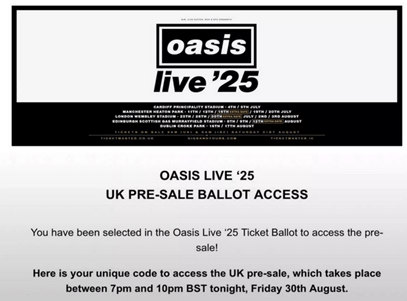
Oasis Pre-Sale – 30.08.24
Live’25 Onsale
When the official Oasis onsale (09.00 BST, 31st August) began access to the ticketing sites was problematic.
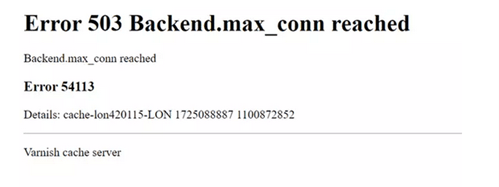
Intermittent Website Message – Oasis Onsale (31.08.24)
Would-be ticket purchasers were also advised by Ticketmaster via X (formerly Twitter) to ‘Please clear your cache/cookies and ensure you aren’t using any VPN software on your device/WiFi. If this doesn’t help, please try using a different browser/device or using mobile data instead of WiFi. Thanks!’
As was widely reported at the time, mobile network Three estimated that 36.2 million devices were directed towards the Oasis onsale, with each potential ticket purchaser attempting to access the onsale via an average of 2.6 devices to maximise their chance of success i.e. 14 million Oasis ‘fans’.
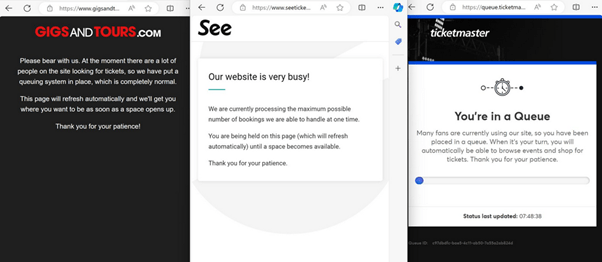
GigsAndTours / SeeTickets / Ticketmaster (UK) – (31.08.24)
There are obviously very few ecommerce systems that can cope with, or gate control that level of demand. So maybe the onsale should have designed a little differently, for example with a higher level of balloted access after customer verification, and/or different onsale dates and times for individual concerts etc. Nevertheless, the decision was taken to put all the tour dates onsale in one dump and to hell with the consequences – after all, all-publicity-is-good-publicity, and the pursuit of the (inevitable) ‘sold out’ PR appeared to override all other considerations.
Despite the official ticketing websites struggling (for hours) to introduce and/or maintain an online queue, or consistently process purchase orders, by the end of the day Oasis and their promoters reported an overall 1.4 million tickets were sold, with an extra three stadium dates announced, and ‘insiders’ reporting over £400M in gross revenues.
So, that is obviously a major success.
There was however widespread consumer frustration with the overall ticketing process, amplified by the apparent failure of the sites to cope with the demand for tickets, or once they were able to connect the extreme length (multiple hours) of the online queue, and then the inability to automatically process their ticket purchase with thousands of customers complaining that they were either held in limbo for hours and/or arbitrarily thrown out of the queue and forced to start-again.
But the loudest complaint was for the previously unannounced mid-onsale implementation of ‘In Demand Pricing’.
***
Live’25 – Ticket Pricing
Initially, ticket prices for the band’s Wembley Stadium concert had started at £74.25, with the most expensive being a £506.25 package that included a pre-show party, exhibition, and seating.
The most affordable tickets were at Cardiff’s Principality Stadium, costing £73 each or at Edinburgh’s Murrayfield Stadium at £74 each.
Standing tickets at Wembley were priced at £151.25, while those in Cardiff and Edinburgh were slightly cheaper at £150 and £151 respectively.
In Manchester, tickets started from £148.50, with only standing options available (due to the lack of infrastructure at Heaton Park) alongside a range of hospitality and luxury packages.
Irish promoter MCD stated on its website that prices for both Croke Park gigs in Dublin began at €86.50 excluding booking fees.
***
‘In-Demand’
However, these ticket prices were then changed, mid-onsale, especially in the standing areas where ‘demand’ apparently exceeded ‘supply’.
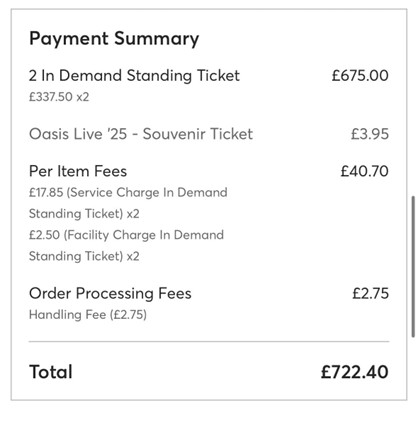
© Ticketmaster (UK )– Oasis In-Demand Checkout (31.08.24)
Amongst the many Oasis fans frustrated by the quality of the onsale service, who then actually bothered to complain to social media, message boards and consumer protection agencies, this blatant gouging of fans for ‘in-demand’ ticketing caused the most grievance with the mainstream media (who are always excited by a ticketing bad-news story), rent-a-quote politicians with lowbrow cultural tastes, consumer rights groups and almost immediately various government spokespersons, whom all similarly announced their alarm and distaste over the cynical use of ‘dynamic’ i.e. surge-pricing during the onsale.
***
Oasis Onsale – Initial Press Coverage
UK Government to probe ‘dynamic’ pricing behind Oasis ticket price surge, Daniel Thomas + Eri Sugiura, 1st September 2024 – https://www.ft.com/content/0c728ded-176a-43b1-9899-086130befd58
Hundreds lodge complaints over Oasis ticket prices, Tom McArthur + Ian Youngs, 2nd September 2024 – https://www.bbc.co.uk/news/articles/c20r26p7d0ro
Inflated Oasis ticket prices ‘depressing’ – government promises review of dynamic pricing, 2nd September 2024 – https://news.sky.com/story/inflated-oasis-tickets-utterly-depressing-government-promises-review-of-dynamic-pricing-13208268
UK government to probe dynamic pricing after Oasis tickets surge, 2nd September 2024 – https://www.reuters.com/world/uk/uk-government-probe-dynamic-pricing-after-oasis-tickets-surge-2024-09-02/
Culture secretary vows to end ‘rip off’ gig ticket sales and review surge pricing, Harry Talor, 1st September 2024 – https://www.theguardian.com/music/article/2024/sep/01/surge-ticket-pricing-to-be-reviewed-as-ministers-decry-vastly-inflated-oasis-prices
Oasis ‘dynamic pricing’ row prompts government probe, Tom McArthur, 2nd September 2024 – https://www.bbc.com/news/articles/c20r26p7d0ro
Oasis onsale prompts investigation into dynamic pricing, 2nd September 2024 – https://www.iq-mag.net/2024/09/oasis-onsale-prompts-investigation-into-dynamic-pricing/
Hundreds file complaints over advertising of Oasis tickets after surge in cost due to ‘dynamic pricing’, Naomi Clarke, 2nd September 2024 – https://www.standard.co.uk/news/uk/oasis-tickets-price-complaints-surge-tour-dynamic-pricing-b1179560.html
***
Dynamic Pricing – Blame Game
Oasis attempted to distance themselves from the ensuing debate: ‘It needs to be made clear that Oasis leave decisions on ticketing and pricing entirely to their promoters and management, and at no time had any awareness that dynamic pricing was going to be used … While prior meetings between promoters, Ticketmaster and the band’s management resulted in a positive ticket sale strategy, which would be a fair experience for fans, including dynamic ticketing to help keep general ticket prices down as well as reduce touting, the execution of the plan failed to meet expectations.’
So, whilst the number and location of the Live’25 concerts, the event production logistics, venue rental + T&C’s, promotion and marketing etc. were presumably all agreed between the band, their live agents, management and the four promoters, the pricing of tickets, or the deployment of dynamic pricing was not.
The promoters – three LN companies (Live Nation (UK), DF Concerts and MCD Productions) together with the ‘independent’ SJM Concerts (who also happens to co-own a number of festivals and venues with Live Nation/Gaiety) all remained silent. Not least because they had nothing to gain by doubting the accuracy of the artist statement, and the typical response is to (always) blame the ticketer.
Ticketmaster meanwhile attempted to deflect attention and/or blame with its usual get out clause, ‘Ticketmaster does not set any ticket prices’ and referred further enquiries to a statement on their website, ‘Promoters and artists set ticket prices. Prices can be either fixed or market-based. Market-based tickets are labelled as ‘Platinum’ or ‘In Demand’.’
So, Ticketmaster was simply obeying the instructions of their inventory suppliers – the promoters and artists – to implement the original and then the revised surge-priced / ‘In-Demand’ inventory which happily for all parties (except the consumer) successfully raised the price of tickets and increased show grosses.
And this is obviously unrelated to the percentage share of the increase in gross that a ticket retailer might expect to receive.
***
As has been asked elsewhere, from a consumer ticket-buying perspective, is there any fundamental difference between a band dynamically pricing their own tickets, or purchasing price-inflated tickets via a secondary marketplace?
Also, rhetorically asked, if the use of dynamic pricing was unauthorised by the band, was there an opportunity to refund the incremental amount charged to their fans?
***
Legal Queries
Culture Secretary Lisa Nandy said she wanted to ensure tickets were sold ‘at fair prices’ saying it was ‘depressing to see vastly inflated prices excluding ordinary fans’ from concerts, adding, ‘This Government is committed to putting fans back at the heart of music. So, we will include issues around the transparency and use of dynamic pricing, including the technology around queuing systems which incentivise it, in our forthcoming consultation on consumer protections for ticket resales’
The Advertising Standards Authority received 450 complaints relating to ‘misleading claims about ticket availability and pricing.’
Sylvia Rook, lead officer for fair trading at the Chartered Trading Standards Institute, stated: ‘In this case, the public were given a price for tickets, and were not informed until they finally got to the front of the queue, that the price had increased.’
‘It is a breach of the Consumer Protection from Unfair Trading Regulations 2008 if a trader misleads consumers regarding the price of goods and services, if that causes the average consumer to take a different ‘transactional decision’. She continued, ‘All relevant information about the price should have been given to consumers before they joined the queue.’
On the 5th September 2024 the CMA (Competition Markets Authority) launched an investigation into Ticketmaster over the Oasis concert sales, ‘including how so-called ‘dynamic pricing’ may have been used’. (https://www.gov.uk/government/news/cma-launches-investigation-into-ticketmaster-over-oasis-concert-sales).
The CMA confirmed that its investigation would consider whether Ticketmaster had engaged in unfair commercial practices which are prohibited under the Consumer Protection from Unfair Trading Regulations 2008. Specifically whether consumers were given clear and timely information to explain that the tickets could be subject to so-called ‘dynamic pricing’ with prices changing depending on demand, and how this would operate, including the price they would pay for any tickets purchased; and whether consumers were put under pressure to buy tickets within a short period of time – at a higher price than they understood they would have to pay, potentially impacting their purchasing decisions.
***
Dynamic Pricing – Not for the U.S.A.
Separately, on the 30th September 2024, Oasis stated via an X post that the Ticketmaster dynamic pricing solution apparently could not cope with ‘unprecedented demand’ and as that would have led to ‘an unacceptable experience for fans’ in North America it was dropped.
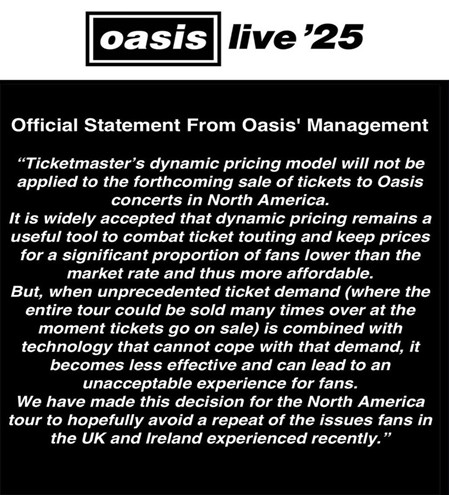
https://x.com/oasis/status/1840742234720702774
***
Postscript
On the 24th March 2025 the CMA confirmed it had previously written to Ticketmaster setting out its concerns under consumer protection law in connection with the Live ‘25 tour sale of tickets and had sought changes to its processes to address those concerns.
CMA seeks changes to the way Ticketmaster labels tickets and provides pricing information to fans, 25th March 2025 – https://www.gov.uk/government/news/cma-seeks-changes-to-the-way-ticketmaster-labels-tickets-and-provides-pricing-information-to-fans
On the 2nd July 2025, the CMA reported to the Business & Trade Select Committee (https://committees.parliament.uk/publications/48593/documents/254728/default/) that after a thorough investigation, it had identified the following consumer law concerns in relation to the Oasis onsale:
Labelling certain seated tickets as ‘platinum’ and selling them for near 2.5 times the price of equivalent standard tickets, without sufficiently explaining that they did not offer additional benefits and were often located in the same area of the stadium. This risked giving consumers the misleading impression that platinum tickets were better.
Not informing consumers that there were two categories of standing tickets at different prices, with all of the cheaper standing tickets sold first before the more expensive standing tickets were released, resulting in many fans waiting in a lengthy queue without understanding what they would be paying and then having to decide whether to pay a higher price than they expected.
The CMA further stated that on the 24th March 2025 it had set out in detail its concerns to Ticketmaster that it may have breached consumer law, and the company was given an opportunity to respond and agree undertakings.
Ticketmaster apparently provided its response on 16th June 2025.
Having carefully considered that response, the CMA’s view is that there is a fundamental disagreement about whether Ticketmaster’s practices infringed consumer law, and that ‘given that no undertakings have been offered or agreed, is now preparing to litigate the matter if necessary.’
***
It will be argued by some that most of this post is irrelevant to those attending and enjoying the Oasis Live’25 spectacle.
But the distasteful and exploitative treatment of the Oasis fanbase is not just bad business practice, it is also, at least in the view of the CMA, illegal.
Comments, and/or corrections via the usual channel.
Until the next time.
 TJ_Chambers